A single photo can make someone pause. But three well-chosen images can make them move — from curiosity to connection to conversion. This is the power of the 3-shot sequence: a visual rhythm that builds trust and momentum without saying a word.
Thesis
While a micro-narrative shot delivers a brand promise in one frame, a 3-shot sequence creates a journey — a visual campaign that mirrors how people decide: see → feel → act.
- See (The Invitation)
The first image should spark recognition. It’s not about showing your product — it’s about showing your world. Use light, texture, and framing to invite the viewer into a scene that feels familiar but intriguing.
Example: A wide shot of a cozy café corner with soft morning light and a half-read book — not the coffee, but the ritual.
- Feel (The Emotional Hook)
The second image deepens the mood. It should evoke a feeling that aligns with your brand voice — comfort, ambition, rebellion, serenity. This is where color grading, facial expression, and composition do the heavy lifting.
Example: A close-up of hands wrapping a warm mug, steam rising, soft focus on a smile in the background — the feeling of “home.”
- Act (The Brand Promise)
The third image is the pivot. It should imply a next step — not a hard sell, but a visual cue that says: this experience is available to you. Think of it as a visual CTA.
Example: A takeaway cup on a counter with a handwritten note: “See you tomorrow?” — the brand promise of consistency and care.
Case Study: Premium Hotel Brand
Brand Voice: Sophisticated, serene, quietly luxurious
Audience: Affluent travelers seeking meaningful, restorative experiences
Goal: Reinforce emotional value beyond amenities — sell a feeling, not just a room
The 3-Shot Sequence
- See (The Invitation)
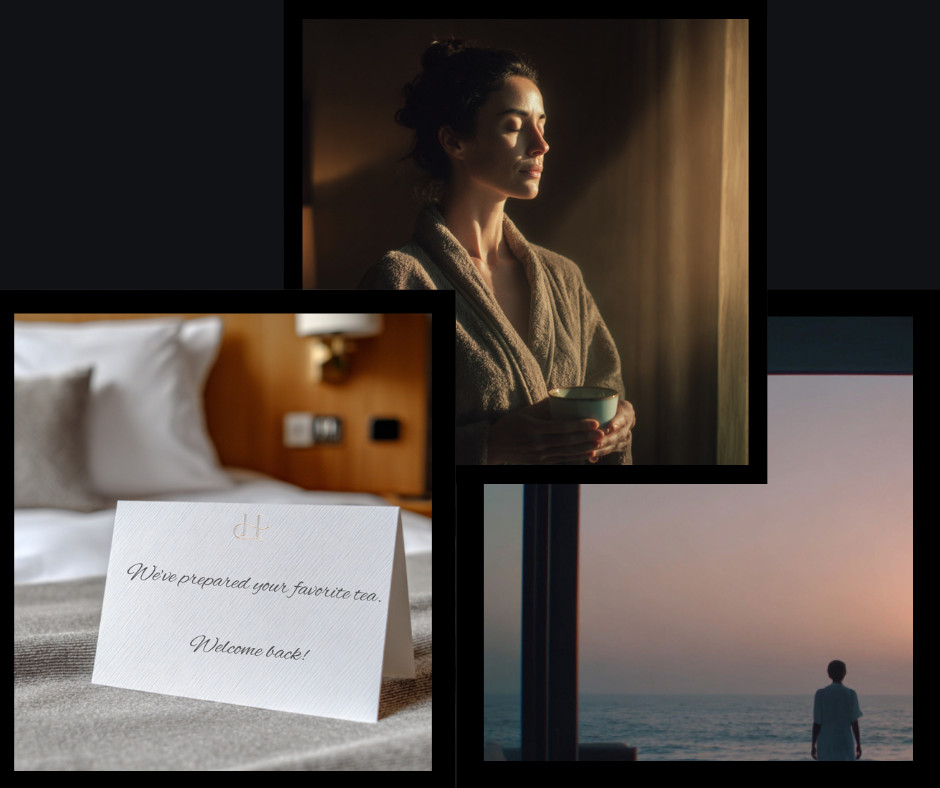
A wide, cinematic shot of a guest stepping barefoot onto a private balcony at sunrise. The ocean is still, the light is soft, and the horizon is open. No logos, no room service trays — just space and stillness.
Message: “This is where your day begins — with intention.”

- Feel (The Emotional Hook)
A mid-shot of a guest in a plush robe, eyes closed, holding a cup of tea, bathed in golden light. The room is blurred behind her, but the textures — linen, wood, ceramic — speak of quiet luxury.
Message: “You don’t just stay here. You exhale here.”

- Act (The Brand Promise)
A close-up of a handwritten welcome card on a turned-down bed: “We’ve prepared your favorite tea. Welcome back.” The hotel’s name is embossed subtly on the card.
Message: “We remember you. You belong here.”

Why it works
This sequence doesn’t sell the room — it sells the return. It mirrors the emotional arc of the ideal guest: I want peace → I feel cared for → I’m coming back. The brand becomes not just a destination, but a ritual.
This approach is especially powerful for larger brands because it:
- Reinforces consistency across global locations while allowing local nuance
- Builds emotional equity — the kind that drives loyalty and repeat bookings
- Creates modular content for campaigns, social, and print — all from one shoot
Would you like me to help adapt this case study into a visual storyboard or a pitch deck format for client presentations?
Try This: The Sequence Sketch
Before your next shoot, sketch your 3-shot sequence like a storyboard:
- Frame 1: Scene — where does your brand live?
- Frame 2: Emotion — what does your brand feel like?
- Frame 3: Promise — what’s the next step you want your viewer to take?
Coming Soon
In the next post, I’ll show how to build a 3-shot sequence using just your phone and natural light — no studio, no gear, just intention and intuition.
If you’ve got a single image you love, let’s build the other two around it. Drop it in the comments or DM me — I’ll help sketch your sequence.